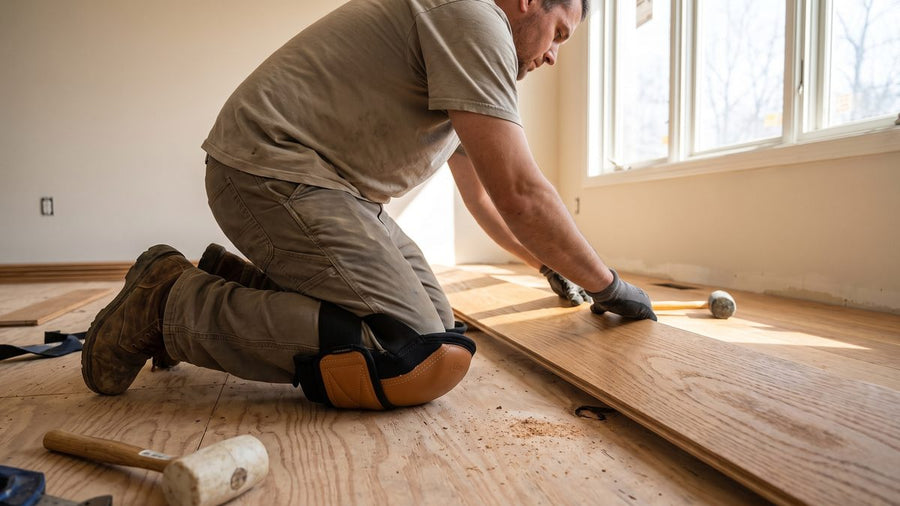
Key Takeaways
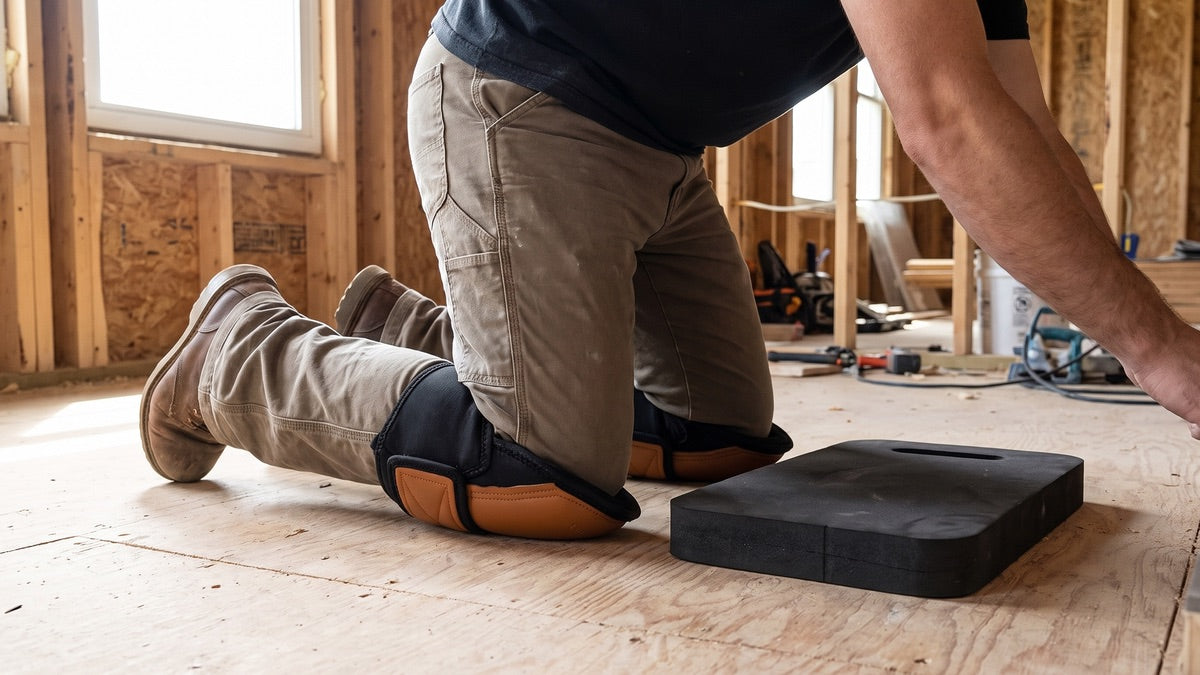
- A kneeling pad stays on the ground; knee pads stay on your body. Every other difference — comfort, mobility, cost, habits — flows from that one split.
- Stationary work favors a kneeling pad: bigger cushioning surface, nothing strapped to your legs, and you can wear shorts in summer.
- Up-and-down work favors knee pads: the protection is already on you when you drop to a knee, and you can't leave it in the van or in the wrong room.
- NIOSH (CDC) found carpet layers kneel through as much as 75% of their workday — which is exactly why the "how do you move" question decides which protection works.
- Many trades workers skip the either/or entirely: pads on the legs for the move, plus one or two kneeling pads staged around the work area.
- If you choose knee pads, the second decision is strap-on pads versus work-pant inserts — strap-on for heavy daily kneeling, inserts for lighter routines.
Kneeling pad or knee pads isn't a question of which product is better — it's a question of how you work. If you kneel in one spot for long stretches, a kneeling pad on the ground wins: more cushion, nothing on your legs. If you're up and down all day, knee pads win, because the protection is already on you when your knee hits the deck. Plumbers on r/ukplumbing argue this exact split, and the ones who do both kinds of work often carry both. Here's how to run that decision for yourself — and where HMYL EASY's soft work knee pads fit into it.
What Each One Actually Is
A kneeling pad (also sold as a kneeling mat) is a portable cushion you place on the floor and kneel on top of — usually a slab of closed-cell foam, sometimes gel or memory foam, sized somewhere between a placemat and a small suitcase. Our gardening comparison covers how this plays out for gardeners choosing between mats, stools, and straps.
Knee pads are protection you wear. Two straps hold a padded shell over each knee, or you slide knee pad inserts into the knee pockets of work trousers. Either way, the cushion travels with your body — down a joist bay, into a crawl space, wherever your knees end up.
Both exist for the same reason: kneeling on hard surfaces all day, for years, is rough on knees. NIOSH (CDC) issued a formal alert on carpet layers — who kneel through as much as 75% of the workday — citing knee disorder rates far above the national worker average. The gear question is just about which shape of protection matches your work.
The Real Difference: How You Move, Not How Much You Kneel
Most comparison articles stop at "one goes on the ground, one goes on your legs." True, but useless for deciding. What settles it is your work pattern — whether you kneel in one place or drop and stand all shift.
The r/ukplumbing thread on this split is a perfect cross-section. The stationary camp: "Kneeling mats. I can be on my mat all day and be fine… Plus means you can wear shorts in the summer." The mobile camp: "Knee pad inserts worked better for me when I was house bashing — more convenient than dragging a kneeling pad around from room to room." A carpenter landed on the same side: "Kneeling mats have their uses but are not practical when balancing on joists or climbing through attics."
So before you buy anything, answer one question: each day, do you kneel in one spot and stay there, or do you drop a knee twenty times in twenty different places?
When a Kneeling Pad Wins
Pick a kneeling pad when your work is stationary and ground-level:
- Long, fixed kneels. Tiling a bathroom floor, laying a section of carpet, detailing a car, planting a bed. You know where you'll be for the next hour, and the pad can live there.
- You hate stuff on your legs. The most common complaint in every trade thread: straps that pinch, pads that slide, sweat in summer. A kneeling pad has none of that.
- Delicate surfaces. A mat cushions your knees and protects the floor under them — finished hardwood, fresh tile, a customer's lawn.
- Budget. A decent kneeling mat costs less than a quality pair of strap-on pads. For a homeowner who kneels six times a year, that's the right spend.
The failure mode: the pad only protects where it physically is. Leave it in the van or one room over, kneel off the edge — you're on bare concrete.

Cleaners live on both sides of this line — the knee pads for cleaning guide breaks down when housekeepers wear pads and when a mat in the caddy wins.
When Knee Pads Win
Pick knee pads when your work is mobile or unpredictable:
- Up-and-down all shift. Plumbing, electrical rough-in, framing, maintenance rounds. You drop a knee for ninety seconds in a different spot each time. As one plumber put it: with pads in your trousers, "you can't leave them on the van."
- Awkward positions. Joist bays, attics, crawl spaces, roof pitches — places you couldn't position a mat even if you wanted to.
- Hard debris. A mat does nothing about the screw or gravel already under your knee when you kneel somewhere you didn't sweep. Pads with a firm face take that hit instead of your kneecap.
- You already know you won't carry the mat. Be honest. The best kneeling pad left in the truck protects nothing. Gear you wear beats gear you mean to bring.
Knee pads have their own failure mode: cheap ones slide, and a pad that's migrated off your kneecap is worse than none — you make hard contact exactly where you thought you were protected. Fit quality and strap width matter more than foam thickness. Our flooring knee pads guide goes deeper on what a full-day pad has to survive.

The Honest Answer: a Lot of Pros Carry Both
Here's the part most comparison articles skip. In the real trade threads, plenty of workers refuse the either/or: "Both." "Inserts and kneeling pads." One keeps "two or three pads in the area I'm working so there's usually one within grabbing distance" — while wearing protection on his legs for the spaces between them.
The two products cover different moments: the mat handles the long planned kneels, the pads handle everything unplanned. If your budget stretches that far, it's not overkill — it's how a lot of knees survive a career. The full overview of protection options is in our knee pads for work guide.
If You Go Knee Pads: Straps or Inserts?
One more decision, because "knee pads" is really two products.
Strap-on pads carry more cushion and take more abuse — the right call for daily, heavy kneeling (flooring, tiling, concrete). Look for wide straps that won't bite the back of your legs and a replaceable cushion, because the foam dies long before the shell does. HMYL EASY's soft work knee pads are built exactly that way — soft-shell comfort with a replaceable inner cushion for compatible HM-1001 configurations, so you refresh the wear part instead of rebuying the pad.
Work-pant inserts trade some protection for zero fuss: they live in your trousers, wash with your trousers, never need strapping on. The r/ukplumbing thread is full of insert loyalists — one buys a fresh ten-dollar pair every couple of months and calls it the cheapest knee insurance in the trade. They suit lighter kneeling, drive-heavy routines, and anyone who's sworn off straps for good. Our breathable work-pant inserts cover that side of the line. The cleaning routines differ too — the full breakdown is in our knee pad washing guide.
Frequently Asked Questions
Is a kneeling pad better than knee pads?
For stationary work, yes — bigger cushioning surface, nothing strapped to your legs, and it protects the floor under you. For mobile work, no — a mat only protects where it's placed, while pads follow every knee-drop around the site. Workers with both kinds of work often use both.
Can you use a kneeling pad and knee pads at the same time?
Yes, and many trades workers do: pads or inserts for moving around, plus one or two kneeling mats staged where the long kneels happen. The two products cover different moments rather than competing for the same job.
Are knee pads or kneeling pads better for gardening?
For garden beds where you kneel in one spot, a kneeling pad or garden kneeler is usually more comfortable. For moving around a yard — weeding borders, edging, planting scattered holes — knee pads win. Our gardening comparison breaks this down by task.
Why do my knee pads slide down?
Usually cheap or worn strapping: narrow straps, stretched elastic, or buckles that don't hold tension. Wider straps distribute pressure and grip better, and trousers with knee pockets solve it entirely. If adjusting no longer fixes it, the elastic is spent.
Do professional floor layers use knee pads or mats?
Both, with a lean toward pads. Flooring involves long kneels — where a staged mat helps — but also constant repositioning, which is why NIOSH's research on carpet layers recommends padded knee protection as standard practice. Quality strap-on pads with replaceable cushions are the usual choice for daily floor work.
How thick should a kneeling pad be?
For hard surfaces like concrete, look for at least an inch (25 mm) of dense closed-cell foam, or a gel core for long stretches. Thinner mats suit grass or already-cushioned surfaces. If you feel the floor through the mat on first contact, it's too thin for concrete.
What to Do Next
Figure out your work pattern first — it decides everything. Mostly kneeling in one place? Get a thick kneeling mat and spare your legs the strapping. Up and down all day? That's knee pad territory: the soft work knee pads for heavy daily kneeling, or the work-pant inserts for lighter or drive-heavy routines. And if your knees see both kinds of days, do what the pros in that plumbing thread do — wear the pads, and keep a mat where the long kneels happen.
Sources:
- CDC/NIOSH Alert, "Preventing Knee Injuries and Disorders in Carpet Layers" (Pub. 90-104) — carpet layers kneel through up to 75% of the workday, with knee disorder rates far above the national worker average.
- Jensen LK, et al., "Symptomatic knee disorders in floor layers and graphic designers" (Occupational and Environmental Medicine, 2012) — elevated risk of symptomatic knee osteoarthritis in floor layers with substantial kneeling exposure.
- Wikipedia, "Knee pad" (en.wikipedia.org) — pad construction and the split between hard-shell and soft-pad use cases.
- Reddit r/ukplumbing, "Kneeling mats vs Knee pad inserts" — workers on mats for all-day stationary comfort, inserts for moving room to room, and carrying both (2026).