Key Takeaways
- Cleaning is a moving job: you kneel to wipe a baseboard, stand, push the caddy two feet, kneel again — dozens of times per house. Anything you have to carry and reposition fights that rhythm.
- The kneeling tasks are specific: baseboards, tubs and shower tracks, the floor beside a toilet, inside cabinets, and grout lines a mop can't reach.
- Medicine named a knee condition after this trade — "housemaid's knee" — because kneeling is that constant in cleaning work. The U.S. alone employs about 2.4 million janitors and building cleaners.
- Wet work changes the requirements: pads get soaked, splashed with product, and need washing weekly. A removable cushion you can wash and hang dry beats a sewn-shut pad.
- A soft face matters twice in cleaning — it won't scratch a tub or finished floor, and it grips wet tile instead of skating.
- What you wear picks the format: scrubs favor a strap-on pad over bare legs or thin fabric; work pants with knee pockets favor inserts.
The best knee pads for cleaning are the ones you'll actually wear all day — which means they stay on while you move room to room, survive the wash, and don't scratch a client's tub. That rules out most cheap sport pads fast. HMYL EASY builds soft work knee pads with a removable, washable cushion — the format that fits how cleaning actually happens.
Where cleaning puts you on your knees
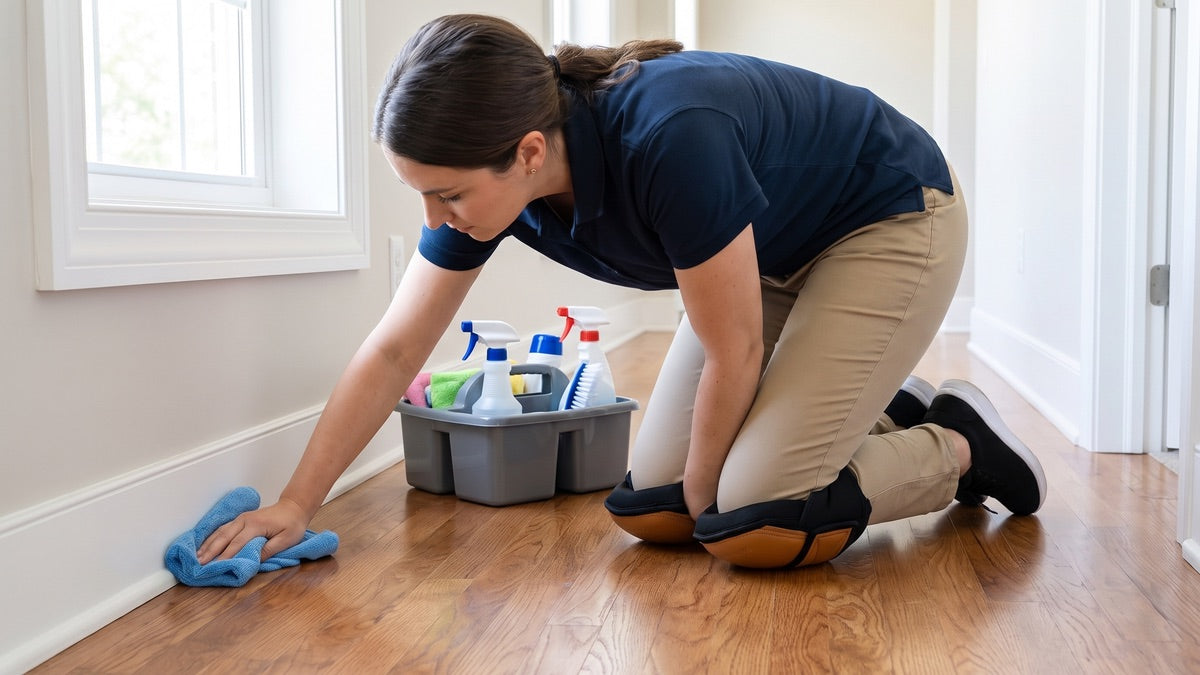
Nobody plans to kneel in this trade. The mop handles the open floor, and then the list starts: baseboards, the tub ring, the shower track, the floor beside a toilet where there's no room to swing a mop, the inside of low cabinets, the grout lines that hold gray no matter how many passes the machine makes.
A housekeeper on r/housekeeping put it plainly after a baseboard day: "My knees are in shambles after wiping down baseboards." The replies ran the whole range — dollar-store garden pads, gel sleeves, pants with knee pockets — because the kneeling hours add up whether you clean one home or three.
They've been adding up for a long time. The knee condition doctors call prepatellar bursitis — irritation of the cushioning sac in front of the kneecap — earned its oldest nickname, "housemaid's knee," from this exact work. Wikipedia's entry on the condition lists housemaids alongside carpenters, plumbers, and roofers as the occupations where it shows up. That's not a reason to worry; it's proof of how much kneeling cleaning involves, and why the good gear in this trade is built around pressure relief.
Scale backs it up: the U.S. Bureau of Labor Statistics counts about 2.4 million janitors and building cleaners, most of them down on tile and bathroom floors every working day.
Knee pads you wear, or a pad you carry?
There are two ways to protect your knees in cleaning, and the right one depends on how you move.
A kneeling pad — the foam slab — works when you park. Deep-cleaning one shower or scrubbing a stubborn kitchen floor, a thick pad under your knees is comfortable, cheap, and disposable. Housekeepers who mostly do detail work keep one in the caddy; one on r/housekeeping describes hers sliding in sideways next to the bottles. We compared the two tools head to head in the kneeling pad vs knee pads guide if you want the full breakdown.
Strapped knee pads win the moment the work moves. A fast-food janitor on r/CleaningTips described the job exactly: "constantly moving & kneeling to scrub the floors, climb inside large cabinets, & dust shelves" — and ruled the pad out because knee pad cushions are "too large & cumbersome for me to just lug around all the time." Room to room, house to house, up and down off the floor forty times, the pad you're wearing is the one that's always in place.
And the honest split is simple: parked detail work suits a mat, everything else suits pads on your legs. Most cleaning days are everything else.
What you wear decides the format
Cleaning splits into two uniforms, and the gear follows.
Housekeepers and residential cleaners mostly wear scrubs or lightweight pants. That means a strap-on pad over bare or near-bare legs, and it makes the strap the whole product. A thin elastic band will chafe by the second house; a wide, soft-backed strap spreads the pressure and stays put through a full up-down day. Skip anything with exposed hard plastic against the leg — in a warm house, in shorts-season, it rubs raw.
Facility and janitorial crews often wear work pants. If yours have knee pockets, knee pad inserts — the slim pads that live inside the pocket — are the zero-effort option: no straps, nothing to take on and off, they ride along all shift and you kneel whenever the job says kneel. The trade-off is padding depth; an insert is thinner than a strapped pad, which is exactly why some cleaners run both depending on the day's building.

Whichever way you go, fit beats features. A pad that's loose migrates sideways the moment you kneel and slide along a baseboard. One housekeeper on r/housekeeping switched to a sock-style sleeve because nothing stayed aligned on her legs — if a strapped pad won't center on you, a snug sleeve is the other wearable answer.
Wet work changes what "good" means
Cleaning is the wettest kneeling trade there is, and it changes three things about the pads.
They need to wash — actually wash. Spray product, tub grime, and floor water soak into a pad that's worn 20+ hours a week. A sewn-shut pad holds all of that until it smells. A pad with a removable inner cushion lets you pull the part that holds moisture and run it through the wash — cold water, gentle cycle, hung to dry, never the dryer. The knee pad washing guide covers the full routine.

The face has to be soft. You'll kneel on a client's refinished tub edge, a hardwood floor, a marble threshold. A hard shell or rugged black cap is a scratching risk you're inserting into someone's home. A soft leather or fabric face cushions and grips instead — it also steadies you on wet tile, where a slick plastic cap skates.
Slim beats bulky in tight spots. The floor beside a toilet, the inside of a sink cabinet, a shower stall — these are exactly the spots that force you to your knees, and a tall, stiff pad catches on the cabinet frame every time you shift. A low-profile pad that covers the kneecap and nothing more lets you get close to the work.
Five checks before you buy
Run any pad — ours included — through these:
- Wide, soft-backed straps. Over bare legs or scrubs, this is the difference between forgetting they're on and counting the hours.
- A cushion you can pull out. Weekly washing is the whole game in a wet trade; sewn-shut pads hold grime and smell.
- A soft, non-marking face. Your knees touch tubs, tile, and finished floors in other people's homes. Nothing on the pad should be able to scratch.
- Low profile. You work beside toilets and inside cabinets. Tall pads catch; slim pads let you get into the corner.
- A strap system that stays centered. Kneel, slide three feet along a baseboard, stand up. If the pad rotated, it fails the job.
Frequently Asked Questions
What are the best knee pads for cleaning?
For cleaning that moves room to room, a strapped pad with wide soft straps, a soft non-scratching face, and a removable washable cushion fits the trade best. If you mostly park in one spot deep-cleaning, a thick foam kneeling pad is the cheaper answer. Work pants with knee pockets open a third option: slim inserts that live in the pants all shift.
Should a housekeeper use knee pads or a kneeling pad?
If you move through a whole house — baseboards here, a tub there — knee pads on your legs win because there's nothing to carry or reposition. If your day is one long stationary detail job, a kneeling pad is more comfortable and costs less. Many cleaners keep pads on and a mat in the caddy for the longest jobs.
Can you wash knee pads that get wet every week?
Yes, if they're built for it. Pull the inner cushion out and wash the shell and cushion on a cold, gentle cycle, then hang them to dry — skip the dryer, because heat breaks down foam and soft leather. Pads sewn shut can only be wiped down, which is why they hold smell in a wet trade.
Will knee pads scratch a client's tub or floors?
A hard shell can — and on wet tile it can also slide. A soft leather or fabric face is the safer choice for finished surfaces: it cushions, grips wet floors, and leaves no mark.
Do knee pads work over scrubs or bare legs?
They do, when the straps are wide and smooth-backed. The failure mode in cleaning isn't padding, it's a thin strap chafing through a full day of up-and-down over bare skin. If a strapped pad won't stay comfortable, a snug sleeve-style pad is the alternative — it wraps the knee with no strap at all.
What to Do Next
Match the pad to your route. Parked on one shower all morning? A kneeling pad is enough. Working houses or buildings end to end? A strapped pad you never take off is the answer — the HMYL EASY soft work knee pads are built exactly for that rhythm: a soft PU leather face that won't mark a tub, wide straps that don't bite, and a cushion that pulls out for the weekly wash.
Cleaning in work pants with knee pockets? Pair the pads with breathable knee pad inserts for the days you'd rather skip straps entirely. For the bigger picture — pads, inserts, sleeves, and which trade each one suits — start with the knee pads for work complete guide.
Sources:
- U.S. Bureau of Labor Statistics, Occupational Outlook Handbook: Janitors and Building Cleaners — about 2.4 million jobs in 2025
- Wikipedia: Prepatellar bursitis — the condition historically nicknamed "housemaid's knee," common in occupations that require frequent kneeling
- r/housekeeping: Knees — housekeepers on baseboard and tub work, dollar-store pads in the caddy, sleeve formats, and pads that fell apart
- r/CleaningTips: Any knee pad recommendations? I have janitor job — a janitor on moving vs. carrying, scrubbing floors, and working inside cabinets