Key Takeaways
- Tile setting is a kneeling trade twice over: hours down on floor tile over a slab, then constant up-and-down for grout, cuts, wall tile, and showers. A pad has to survive both.
- Wet thin-set is what actually kills a tile pad. Abrasive and grit-heavy, it grinds the pad face and soaks the cushion — which is why a pad you can pull apart and wash outlasts one that's sewn shut.
- The trade's default for all-day floor tile over concrete is a hard-shell pro system. Setters on r/Tile call it the only way to go — and it costs several hundred dollars, raises your kneeling height, and comes off the moment you stand up.
- An occupational therapist writing in TileLetter, the tile industry's own magazine, recommends a soft outer shell over a hard shell for installer knee protection, and suggests standing up for 30 seconds every half hour to break the load.
- The blue gel pad most setters start on is the trap. The setter who asked r/Tile had "been using the blue gel knee pads for years" — and almost every pro in that thread had moved off them.
- The loudest complaint isn't the cushion, it's the strap. "The straps of most kneepads tear up the back of my legs," one setter writes. A wide strap with a single-strap option beats an extra half-inch of foam.
The best knee pads for tiling depend on which half of the day you're in. All-day floor tile over a slab is hard-shell territory, and the trade says so. For the other half — wall tile, grout, cuts, showers, cleanup — a soft-faced strap-on pad with a wide strap and a cushion you can pull out and wash is the tool. The HMYL EASY pad we sell is built for that second half, and it's our pick below.
Tile work is two jobs stacked on one pair of knees
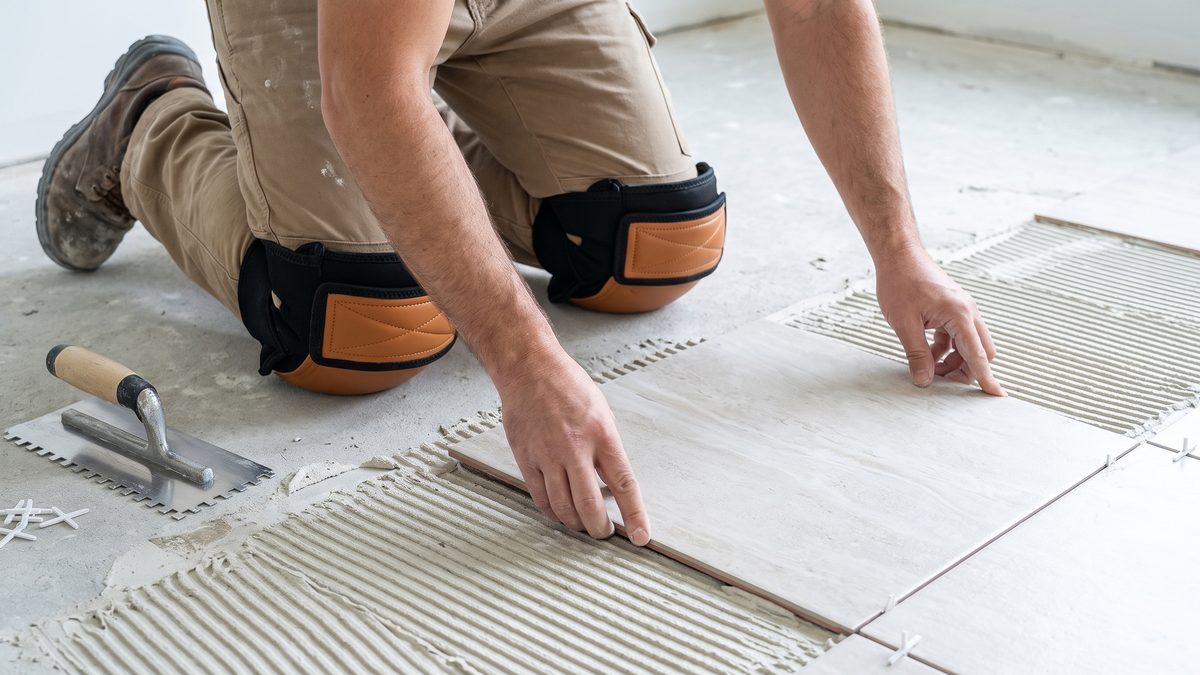
Ask a setter what the day looks like and you get two answers. On a big floor job you're down in the morning and you stay down — spreading thin-set, back-buttering, setting full-body porcelain, checking lippage — for hours at a stretch. On a bathroom or a backsplash you're never in one place: kneeling to grout, standing at the wet saw, kneeling again at the wall, up to move the bucket.
Both patterns are kneeling, and they load a pad in opposite ways. A pad built for the first job is a heavy platform you fight on the second. A pad built for the second gives out on the first. That's why there's no one best tile pad until you know which day you're having more of.
Thin-set is what a tile pad actually fights
Every trade has a surface that eats pads. Flooring has sawdust and adhesive. Tile has thin-set mortar, and thin-set is worse.
It's abrasive, it's wet, and it's full of sand and cement grit. A foam or gel pad that meets wet thin-set gets its face ground down and its cushion saturated. That's how a pad that felt fine in the store smells like a bucket by Friday. One setter in the r/Tile thread says he ends up throwing "the whole unit in the washing machine to get the funk out every week or two" — because his pads don't come apart.
Under the mortar, porcelain, stone, and concrete don't give. A cushion that springs back under your thumb can still bottom out under your full body weight on a slab — and once it does, you're kneeling on the substrate with a strap around it.
How a tile day loads a knee pad
Three loads, and only one of them is the cushion.
A hard, unforgiving substrate. Tile and slab have no give, so all the cushioning comes from the pad. Rebound matters more on tile than on any wood or carpet job.
An up-and-down rhythm. Grout, cuts, wall tile, and cleanup keep you standing and kneeling all day. Heavy pro systems get left in the truck for these jobs, and a pad you take off is a pad you forget to put back on.
Pivoting and reaching. Setting a floor means kneeling at the edge of fresh thin-set and twisting to reach the far side. On a wet floor, a pad that rolls or slides is a stability problem, not just a comfort one.
Occupational knee loading is one of the better-studied exposures in the trades: a systematic review in Safety and Health at Work found a dose-response link between time spent kneeling at work and knee osteoarthritis.

The trade's real split: hard shell or soft face
Most buying guides answer this with "hard caps for rough ground, soft caps for smooth." Tile work breaks that rule, and the honest answer is that the trade itself is split.
The hard-shell pro systems are everywhere on tile, and for a reason. For eight hours of floor tile over a slab they move load off the kneecap and down the shin, and setters who've worn them for years credit them for staying in the trade. If that's your day, it's the right tool — and it's worth the price.
But the shell carries costs the brand pages skip. It raises your kneeling height, which takes real adjustment after years of working low, and it's heavy enough that setters pull it off for the standing parts of the job. It's also overkill for wall tile, backsplash, and grout, where you're never parked in one spot.
The soft-face case is stronger than the listicles admit. In TileLetter, the magazine of the National Tile Contractors Association, occupational therapist Marissa Marchioni — an assistant professor of clinical occupational therapy at USC — recommends a knee pad with a soft outer shell rather than a hard one for installers. In the r/Tile thread, the setters who don't run a pro system tend to land on the same soft leather strap-on pad, calling it "much lighter and easier to move around in" than the alternatives and the pick when you're "up and down" rather than parked on the floor.

Five checks before you buy a tiling pad
Run any pad — ours included — through these:
- Cushion rebound, not depth. Press it. It should push back. On tile or slab, a plush pad that doesn't recover flattens by lunchtime.
- Strap width and count. The loudest complaint in the trade isn't padding — it's the strap biting the back of the leg. A wide strap that grips the pant leg, with a single-strap option, beats a thin elastic band.
- A cushion you can pull out and wash. Thin-set grit and sweat are a bad pair. When the cushion comes out, you wash the part that holds moisture. Sewn shut, the smell and the pad both have an expiry date.
- An abrasion-resistant face and a non-marking underside. The face takes the grit; the underside meets tile that's already set. A pad that scuffs a finished floor is a pad the homeowner will notice.
- Mobility — the best pad is the one you keep on. Bulk is only worth carrying if you're down for hours. If you're up and down, a lighter pad you forget you're wearing protects you more than a heavy one left in the truck.
Whatever you buy, keep it clean — grit-clogged pads wear faster and smell worse. The knee pad washing guide covers the routine.
Frequently Asked Questions
What knee pads do tile setters use?
Two camps. Setters on all-day floor tile over a slab mostly run hard-shell pro kneeling systems, which shift load to the shin but cost several hundred dollars and sit high. Setters who move between wall tile, grout, and cuts mostly run soft leather strap-on pads or pocket inserts.
Are hard or soft knee pads better for tiling?
It depends on the day. Hard shells win when you're parked on a slab for hours, because they spread load across the shin. Soft pads win for wall tile, grout, cuts, and showers, where you're up and down and a heavy shell becomes something you take off and forget.
Why do my knee pads smell after tiling?
Thin-set grit, sweat, and body oils soak into the cushion and don't dry out. If the cushion is sewn in, you can only wipe the outside, and the smell settles in. A removable cushion lets you wash the part that holds moisture and dry it completely.
How do I stop knee pads from sliding down while setting tile?
Choose a wide strap that grips your pant leg rather than a thin elastic band, and snug the lower strap first — it carries most of the load. If everything still slides, pocket inserts inside your work pants remove the problem entirely.
Can you wear knee pads under work pants for tiling?
Yes, and plenty of setters do. Pocket inserts slide into the knee pockets sewn into most work pants and stay there, so nothing sits behind the knee and nothing needs adjusting. They suit days when you're moving between rooms better than eight hours on a slab.
What to Do Next
Match the pad to the half of the job that fills most of your week. All-day floor tile on a slab: a hard-shell pro system is the trade's answer, and it earns its price. Everything else — wall tile, grout, cuts, showers, cleanup — a soft-faced pad with a wide strap and a cushion you can replace.
The HMYL EASY soft work knee pads we sell have a soft PU synthetic-leather face, X-reinforced stitching, adjustable wide straps, and a removable inner cushion you can wash or replace. Spend tile days in knee-pocket pants? Pair them with breathable knee pad inserts and skip the straps.
For the full picture of all three pad types, start with the knee pads for work complete guide. Want the material story behind a soft leather face? See the leather knee pads guide. And if your week is split between floors and walls, the flooring knee pad guide covers the substrate side of the call.
Sources:
- TileLetter (NTCA): The knees have it — occupational therapist Marissa Marchioni, OTD, OTR/L, CEAS, of USC on positional variety, a soft outer shell over a hard one, and 30-second breaks every half hour
- Safety and Health at Work: Occupational Exposure to Knee Loading and the Risk of Osteoarthritis of the Knee — systematic review and dose-response meta-analysis of occupational knee loading
- Cleveland Clinic: Prepatellar bursitis — repeated kneeling as an occupational cause of swelling in front of the kneecap
- r/Tile: What knee pads do you wear? — working setters on pad choice, strap bite, and pads they have to wash whole