Key Takeaways
- Construction is harder on knee pads than any other trade: gravel, broken concrete, subfloor screws, and finished surfaces all attack the pad in different ways, so the face material matters more than cushion thickness.
- A hard shell makes sense for crawl spaces with rock and nails. For general site work — framing, layout, trim, finishing — a soft-faced pad with a soft PU synthetic-leather face may be gentler on finished floors, though grit under any pad can still scratch them.
- The pads construction workers complain about most on r/Construction aren't the thinnest ones — they're the ones that slide down to the ankles, bite the back of the leg, or wear through the face in weeks.
- A replaceable inner cushion turns knee pads from a consumable into a tool: the face stays, the flattened cushion swaps out.
- If your work pants have knee-pad pockets, breathable pocket inserts that live in the pants full-time are the zero-adjustment option — no straps at all.
- Expect three price tiers on site: five-dollar hardware-store pads that die fast, mid-range pads balancing face durability with comfort, and $150+ pro systems — great on knees, bulky in tight spaces.
For mixed-surface construction work, consider soft-faced strap-on pads with a soft PU synthetic-leather face, an adjustable wide strap, and a replaceable cushion. The HMYL EASY pad we sell uses that configuration, and it's our pick below. But construction wears pads differently depending on what you're kneeling on — here's how to match the pad to the job instead of trusting a top-five list.
Construction is harder on knee pads than any other trade
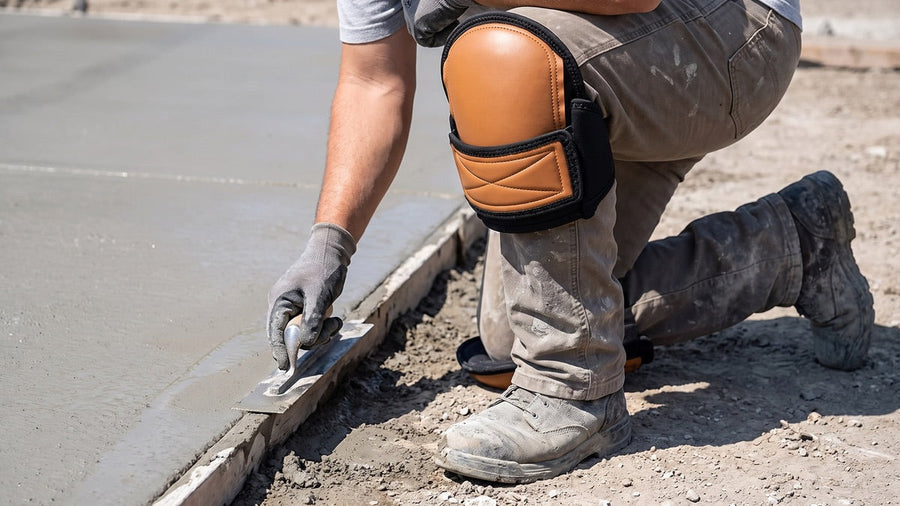
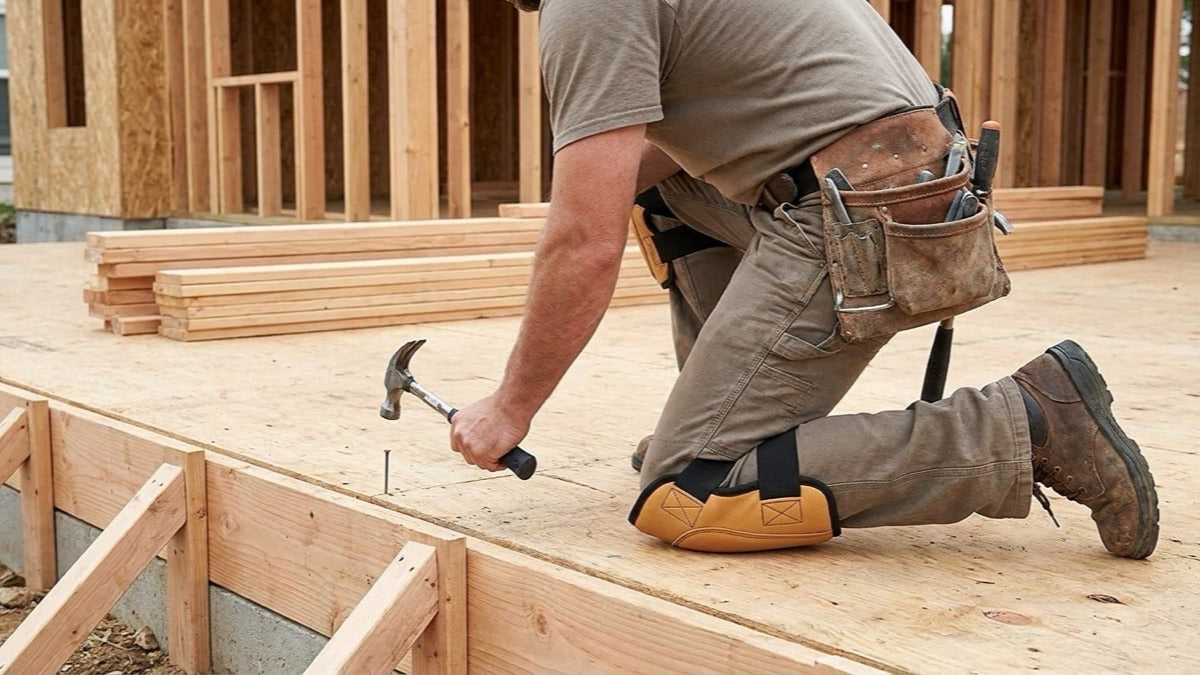
Flooring guys kneel on smooth substrates. Roofers kneel on shingles. Construction workers kneel on everything — gravel, broken concrete, plywood subfloor with screws proud of the surface, and, on the same job, a just-finished floor you absolutely cannot scratch.
That variety is what kills pads. A cushion can be thick and still useless if the face wears through in three weeks. A stone worker on r/Construction put it bluntly when someone suggested fabric pads: how is the outer layer supposed to survive "being ground beneath your knee" on abrasive material day after day? That's the real failure mode on site — not the cushion going flat, the face going through.
The second thing construction does differently: you're up and down constantly. Unlike a floor installer who's down for hours, a framer or general contractor might drop to one knee forty times a morning. A pad that slides down or twists off the kneecap during that rhythm is worse than no pad, because you stop trusting it and stop wearing it. An older carpenter on r/Construction said it as well as anyone: the best knee pads are the ones on your knees. The perfect pair left in the truck protects nothing.
Hard shell or soft face: the big call on rough ground
This is the one decision that splits construction from every other trade.
If you're crawling crawl spaces, gravel, or demo debris, you need a hard shell. Rock and nail points punch through soft faces. On r/Construction, crawlspace workers are clear: soft pads work on dirt and light debris, but rocky or broken-concrete crawlspaces call for hard-shell pads.
For everything else on a typical site, a soft face wins — if it's the right soft face. Here's why:
- A hard shell concentrates your body weight under the kneecap. Kneel on that for a finishing shift and your knees know it by hour four.
- Hard shells slide on smooth surfaces — plywood, finished concrete, tile — which is its own safety problem.
- And the moment the job touches a finished floor, hard plastic becomes a liability — skateboard-pad guys talk about wrapping them in towels so they don't scuff. A workaround, not a solution.
The middle path is a soft-faced pad — a cushion behind a flexible soft PU synthetic-leather surface. A soft surface may be gentler to finished floors than a hard cap, but grit trapped under any pad can still scratch a floor. Fit and wear depend on the task and surface. For more on the material, read the PU knee pads guide.

The two setups that work on a real job site
Forget brand lists. On site, two setups actually hold up, and most of the satisfied workers on r/Construction run one of them.
Setup 1: Soft-faced strap-on pads with a replaceable cushion. This is the all-rounder for up-and-down site work. You want three things: an abrasion-resistant face, a wide strap that doesn't bite the back of your knee, and — the part most buyers miss — a replaceable inner cushion. The cushion is the first thing to flatten, and on a pad with a fixed cushion, flat means dead. On a pad where the cushion swaps out, the face you've broken in keeps working and you refresh the part that wore. Workers describe pads built this way as "another tool, not a disposable." For long stretches down on bad ground, the most comfortable knee pads for work breaks down what keeps a pad comfortable hour after hour.
Setup 2: Pads that live in your work pants. If you wear pants with knee-pad pockets — most major workwear brands sell them now — breathable pocket inserts slide in and stay there full-time. No straps, nothing behind your knee, nothing to adjust. The tradeoff is a thinner cushion than a strap-on pad, so this setup suits the up-and-down rhythm better than all-day kneeling — but the protection is already on your legs the moment you drop. Electricians lean on this setup heavily — see how trades with pocket pants run inserts — and it works the same on a construction site.
A third option — pull-on sleeve pads — mostly lives in other trades: the fabric behind your knee gets hot and chafed over a full site day, and most sleeves are hand-wash-only, a smell problem by Friday.
What to check before you buy
Run any pad — ours included — through these five checks:
- Face material. Drag-test it mentally against gravel and rough plywood. Fabric, PU, and hard-shell faces wear differently. Choose for the ground you kneel on and inspect the pad for damage.
- Strap width and grip. Narrow straps dig in behind the knee and slide down skinny legs. A wide strap that grips the pant leg stays put through forty knee-drops a morning.
- Cushion you can replace. Press the cushion. If it bottoms out under your thumb, it'll bottom out under your weight on concrete. And if it's sewn shut, the pad has an expiration date.
- Scratch risk. If any of your week happens on finished floors, skip hard caps or plan to keep a second pair of soft-faced pads for those days.
- Real price tier. Five-dollar pads are a false economy on a construction site. At the top, $150+ pro systems are bulky in tight spaces — crawlspace guys say they "catch on everything." The sweet spot for most site work is mid-range: a durable face and a real cushion without the bulk.
Whatever you buy, keep it clean — dust-clogged pads wear faster and smell worse. The knee pad washing guide covers the routine.

Frequently Asked Questions
Are hard or soft knee pads better for construction?
Hard-shell pads may be preferable on rock, broken concrete, or nail-studded debris. On smoother surfaces, a soft-faced pad may be easier to move in. Check for grit under any pad before using it on a finished floor.
How do I stop knee pads from sliding down on the job?
Choose a wide strap that grips your pant leg rather than a narrow elastic band, and snug the lower strap first — it carries most of the load. If pads still slide on skinny legs, single-strap pads that anchor below the knee — or pocket inserts — eliminate the problem entirely.
Can I kneel on concrete all day in soft pads?
Yes, if the cushion is deep enough to not bottom out and the face can take the abrasion. The failure mode on concrete isn't softness — it's a cushion that flattens by mid-shift. A layered cushion that springs back — ideally one you can replace when it compresses — keeps all-day concrete work tolerable. If finishing pours is your main gig, the best knee pads for concrete guide breaks down what the wet side and the dry side each demand.
Do knee pads work with work pants that have knee-pad pockets?
That's exactly what they're for. Breathable pocket inserts slide into the knee pockets sewn into most modern work pants and stay there permanently — no straps, no adjusting, nothing to forget in the truck. The cushion is thinner than a strap-on pad, so they suit up-and-down work better than hours-down finishing.
How long should construction knee pads last?
Service life depends on the work surface, frequency of use, and maintenance. A replaceable inner cushion lets you refresh that part when it wears without automatically replacing the whole pad.
What to Do Next
Match the pad to your ground. Crawlspace and demo crews: hard shell, no debate. Everyone else on a mixed-surface site: a soft-faced strap-on pad with a wide strap and a replaceable cushion.
The HMYL EASY soft work knee pads we sell have a soft PU synthetic-leather face, X-reinforced stitching, adjustable wide straps, and a removable inner cushion that can be washed or replaced. Working in pants with knee pockets all week? Pair them with breathable knee pad inserts and skip the straps entirely.
For the full picture of all three pad types, start with the knee pads for work complete guide. On your knees for hours instead of up and down? The flooring and tiling knee pad guides run deeper on all-day kneeling. Off the clock in the garden? The gardening knee pad guide covers soft ground and shorts weather.
Sources:
- Wikipedia: Prepatellar bursitis — repeated kneeling as an occupational cause of "housemaid's knee"
- Verbeek et al., Safety and Health at Work (PMC): Occupational knee loading and knee osteoarthritis risk — dose-response meta-analysis — moderate-quality evidence that cumulative kneeling at work raises knee OA risk
- Ezzat et al., Physiotherapy Canada (PMC): Occupational physical loading tasks and knee osteoarthritis — moderate evidence for combined kneeling and heavy lifting jobs in men
- r/Construction: Need kneepads that won't fall to ankles — worker consensus on sliding pads, pocket pants, and face durability
- r/Construction: Best knee pads for crawling on gravel and concrete — hard-shell vs soft-face recommendations for crawlspaces and rough ground